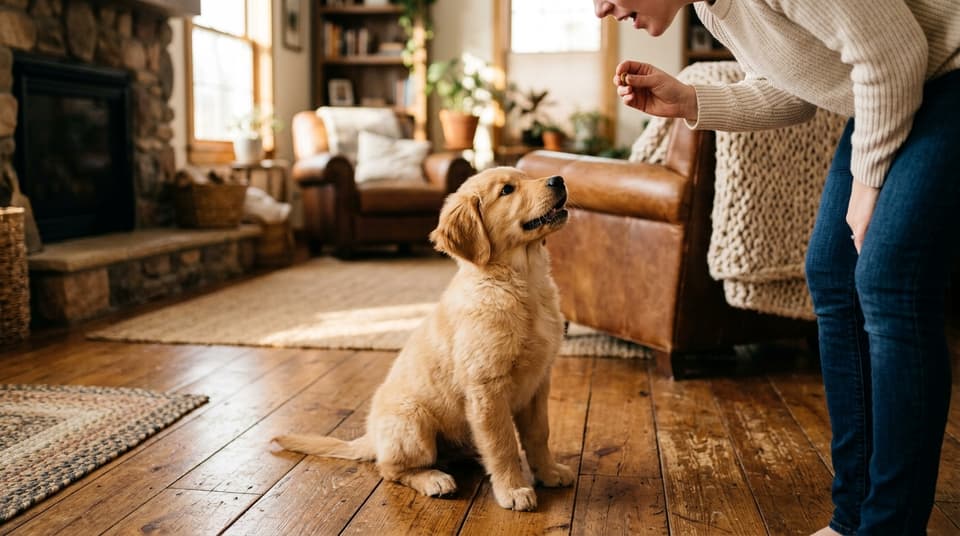
How Do You Teach a Dog to Recognize Its Name?
Say the name once, mark the instant your dog looks at you, then reward it — treat, praise, or play. Repeat in short sessions until the response is automatic. For the science behind why this works, see our guide on how dogs recognize their names.
Teaching a New Puppy Its Name
Start the moment you bring your puppy home, even at 8 weeks old — there’s no reason to wait for formal training age.
Say the Name Once
Use a clear, normal, or slightly upbeat tone. Avoid chanting or repeating the word if they don’t look right away.
Instant Marker Cue
The exact second your puppy’s eyes make contact with yours, mark the behavior immediately with a crisp “Yes!”
Immediate High-Value Reward
Deliver a small training treat, warm praise, or a favored toy within 1 to 2 seconds to reinforce the connection.
Gradual Distraction Proofing
Begin in a quiet, boring room. Once 90%+ reliable, introduce mild household distractions, then outdoor environments.
Protect Name Value
Never use the name to scold or punish. If it only predicts good things, your puppy remains eager to respond every time.
- Say the name once, in a normal or slightly upbeat tone. Don’t repeat it.
- The second your puppy looks at you, mark it with a word like “yes,” then reward immediately.
- Run 5–10 short reps per session, a few sessions a day.
- Start in a quiet room. Once it’s reliable there, add mild distractions, then busier ones.
- Never use the name to scold. If it only ever predicts something good, your puppy stays motivated to respond to it.
Most puppies respond reliably within one to two weeks of consistent short sessions. Full reliability around real distractions — other dogs, squirrels, a busy park — takes longer, and that’s normal.

How to Teach a Dog Its Name Without Treats
Treats speed things up, but they’re not required. Praise, a favorite toy, or physical affection all work as the reward — the mechanism is the same: name, attention, reward, repeat. The only real difference is that food tends to be the fastest, most consistent motivator for most dogs, so expect a treat-free approach to take somewhat longer, not fail.
| Reward Method | Learning Speed | Motivation Level | Ideal Scenario | Recommendation |
|---|---|---|---|---|
| High-Value Food Treats Freeze-dried liver, chicken, cheese bits | 1–2 Weeks | Very High | Young puppies & fast initial conditioning | ★ Fastest Method |
| Favorite Toy / Tug Play Ball toss, squeaker, short tug session | 2–3 Weeks | High | Working breeds & high-drive dogs | ✓ Highly Effective |
| Verbal Praise & Affection Excited tone, ear scratches, chest rubs | 3–4 Weeks | Moderate | Calm dogs & strict dietary restrictions | ✓ Steady & Reliable |
How to Teach a Dog Its Name Fast
Three things speed this up more than anything else:
⚡ Core Accelerators of Canine Name Learning
Relative impact of key training variables on rapid name acquisition:
- Consistency of tone. Say the name the same way every time, rather than switching between a dozen nicknames.
- Immediate reward timing. A reward that lands within a second or two of the response teaches faster than one that’s delayed.
- Short, frequent sessions over long, rare ones. Five minutes, three times a day, beats one 20-minute session.
How to Teach a Rescue Dog a New Name
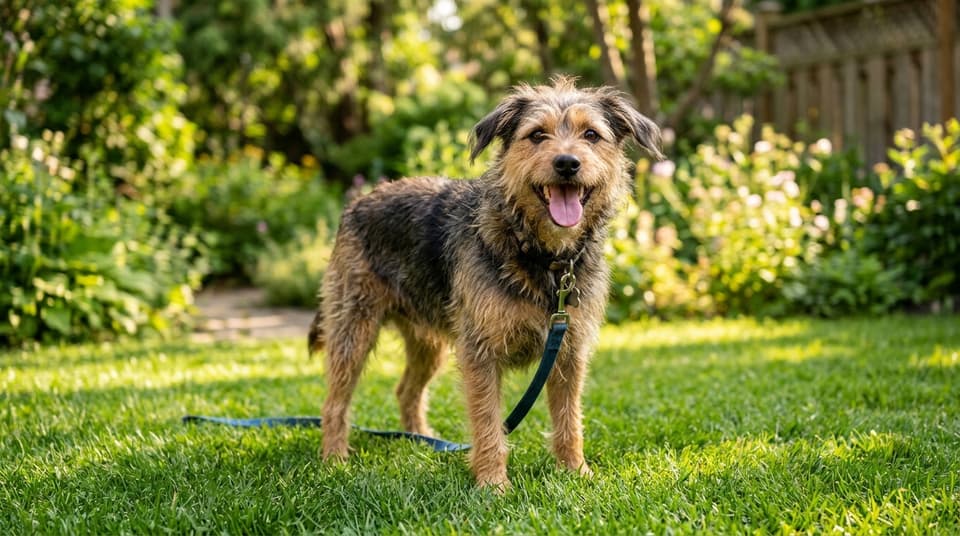
Yes, you can rename an adult rescue dog. Wondering if changing your dog’s name will confuse it? Dogs don’t carry emotional attachment to the specific sound of their old name the way a person would — what matters to them is the reward history behind whatever sound you use. Teach a new name exactly the way you’d teach a puppy’s: say it, reward attention, repeat consistently. Most dogs pick up a new name within a couple of weeks.
✓ Training Best Practices (Do This)
- Say the name only once and patiently wait for eye contact.
- Mark with “Yes!” the exact split-second their eyes turn to you.
- Pair with high-value treats during the first 10 days of adoption.
- Keep your tone cheerful, upbeat, and inviting.
✕ Common Renaming Pitfalls (Avoid This)
- Don’t repeat the name like a broken record (turns into white noise).
- Never use the new name right before baths or nail trims.
- Never call your dog by name to scold or deliver a punishment.
- Avoid 10 confusing nicknames until the primary name is rock solid.
Why Does My Dog Ignore Its Name?
A dog that’s learned its name will still ignore it sometimes — this is rarely stubbornness. The most common reasons:
1. High Environmental Distraction
Something in the environment (a passing squirrel, another barking dog, an enticing scent) out-competes the reward history behind the name cue.
2. An Unpleasant Association
If the name is regularly uttered right before a bath, nail trim, or crate confinement, your dog learns that responding leads to an unwelcome event.
3. Cue Poisoning & Overuse
Repeating the name constantly with no follow-up reward or consequence turns the word into meaningless ambient background noise.
4. Command Word Similarity
Names that rhyme with standard commands (such as “Kit” with “Sit”, or “Bo” with “No”) create genuine acoustic confusion for your dog’s ears.
- Distraction. Something more interesting (a squirrel, another dog) is out-competing the reward history behind the name.
- A bad association. If the name gets used right before something unpleasant — a bath, a nail trim — the dog starts avoiding it instead of responding.
- Overuse. A name repeated constantly with no consequence turns into background noise.
- The name sounds like something else. A name too close to a command word causes real confusion.
If recall specifically is the issue — your dog knows its name but won’t come when called — that’s a related but separate skill from name recognition itself, and worth treating as its own training goal rather than assuming the name itself is the problem.
If Your Dog Is Lethargic and Not Responding to Its Name
🩺 Critical Health Alert: Contact Your Veterinarian
This is different from a training issue, and it’s worth saying plainly: a dog that’s suddenly lethargic and unresponsive to its name may be dealing with illness, pain, a hearing problem, or something else that needs a vet’s attention — not a naming or training gap. If this describes your dog, especially if it’s a sudden change rather than a lifelong pattern, contact your veterinarian rather than troubleshooting it as a training problem.
FAQ
Q How long should it take a dog to learn its name?
Most puppies respond reliably within one to two weeks of consistent short training sessions. Adult dogs, including rescues learning a new name, typically take a similar amount of time. Full reliability around distractions can take longer.
💡 Key Takeaway: 5 to 10 reps, 3 times daily will cement the habit in 7 to 14 days.
Q Why does my dog ignore me when I say his name?
Usually distraction, a negative association with the name, or overuse that’s turned it into background noise. It’s rarely defiance — check what’s happening around your dog and what the name has been paired with recently.
💡 Key Takeaway: Reduce environmental stimulation and re-establish immediate high-value rewards.
Q What should I do if my dog doesn’t respond to his name?
Restart short, consistent training sessions pairing the name with a reward. If the non-response is sudden and paired with low energy or other behavior changes, treat it as a possible health issue and contact your vet rather than only troubleshooting training.
💡 Key Takeaway: Rule out sudden health or auditory issues with a vet before adjusting training.
Q How do I teach an 8-week-old puppy its name?
The same way as any dog: say the name once, reward attention to it immediately, and repeat in short sessions. Puppies this young can absolutely start learning — there’s no need to wait.
💡 Key Takeaway: Early socialization and immediate reward timing yield rapid recall.
Find the Right Name First
A name that’s short, clear, and easy to say consistently is also easier to teach. If you haven’t picked one yet, try our dog name generator.